


During my 2 years owning a property management business 8 years ago and the last 8 years learning and applying property management SEO for the 200+ property management companies on our monthly plans, I have seen the ROI of local SEO compared to things like PPC ads, pay-per-lead services, and even social media advertising (the best of the ad options).
My First Call From Google: When I started my own property management company 8 years ago, before I grew it to 172 doors in around 15 months, I’ll never forget the first call I got organically from Google.
My cell phone was the business number on Google, so I answered “Hey this is Landon” (not in the habit yet clearly) and the person on the line confusingly asked if we were the property management business. I quickly regained my footing and got through the call asking how they found us. He mentioned just Googling local companies, checking reviews and websites. It was one call but I felt like I had made it.
There is nothing that compares to the return on investment of a property management company doing SEO successfully. It’s kind of impossible to compare, because the ROI on local SEO strategies continues to go up with time.
I dropped a word in that last paragraph that makes all the difference between “doing SEO” with zero to minimal results, or “doing SEO” and getting tremendous exposure to rental property owners searching for property management services in your area.
The word? SUCCESSFULLY. Doing SEO, successfully, the right way with a solid property management SEO strategy.
Most SEO advice for property managers stays general and doesn’t give enough actionable tips, so I’m writing this. I’m ok to give more and share the best practices, even if it stops some people from becoming our clients because they try to do it themselves.
That’s the reason I’m writing this article (well, that plus the fact I’m on an 11-hour flight from Europe to Thailand).
In this post, I’m going to pretty much give you the exact tactics and strategy for property management SEO that we follow here at Goodjuju for the 200+ property management companies on our monthly plans. I’ll include practical examples and guidelines on what you need to do to see real results.
Google’s algorithm is crazy good, and because this SEO resource will be incredibly helpful (I’ll do my best), it should appear in the top few spots of the organic search engine results pages (which by itself is an SEO lesson worth pondering).
It will be your choice if you decide to try and implement these strategies by yourself (internally) or hire a professional SEO company for these SEO services to take your property management business to the next level.
What Is “Successful” Property Management SEO?
It’s a lot of things, which we will get into, but it’s easier to quickly explain what it’s not.
SEO is not posting blogs about generic property management topics on your property management site that bring no real value to the owners and tenants who come to your site.
SEO is not writing daily posts on your social channels about generic topics or tips in property management marketing.
Here’s my own definition of local SEO, off-the-cuff, and specific to local search results and the property management industry.
My definition of what SEO is when being done as it should be:
“The process and strategy of helping a search engine like Google know about the existence of your business, what you do, where you do it, your expertise, how you do it, why you do it, who you are, who your clients are, the quality of your service, what clients think about you, what relevant industry peers and other locals think about your business. This is done with your property management company’s website, making it essential to get the page optimization of your site done well through strategies like keyword research, building location pages, and targeted content creation to improve online visibility and ranking, your google business profile, social media, and other websites/sources.“
This guide breaks down what matters, what people forget, and what you can do right now to improve your SEO keyword rankings and website traffic.
Why it matters: in our 2026 study of 35 property management companies (294,281 website visitors and 2,525 owner leads, spring and fall 2026), Google Search and the Map Pack brought in 50.6% of owner leads in the fall window, more than every other source combined. Read the full property management lead source report.
1) Start With The End: SEO For Property Managers Has An End Goal Of New Owner Clients
Many property managers treat SEO like a generic list of tactics: write content, add relevant keywords, build links, repeat.
These are a few generic pieces of the SEO puzzle, but it works better when you define your ultimate goal and then reverse engineer your property management SEO strategy in a niche specific way.
Doing this will bring you more of the right people.
Maybe that’s property owners and real estate investors looking for a property manager? Random guess.
Just “getting more traffic” isn’t a good goal. More traffic can actually be a problem if it brings the wrong people (like tenant only searches) and wastes time. The real goal is getting the right owners and investors to find you, and then to take the next step.
If you get this part right up front, the rest of your SEO decisions get easier. Things like what service pages to build, what property management SEO specific keywords to target, what website content to write, and what you should ignore.
Define the outcomes you care most about (I’ll “assume” I know what they are)
- Owner and investor leads
- Calls and rental analysis form requests, etc.
- If you have an “ideal client” (out-of-state, accidental landlord, investor, HOA, etc.)
What you need to do:
- Pick your #1 SEO conversion: Call, rental analysis form inquiry, unique CTA
- Write down your top 2 property owner or investor types
- Decide what “qualified lead” means for you (property types, doors, areas, owner)
Video Example of Good CTAs:
2) Start Building Credibility Signals (Because Owners and Google Both Look for Proof)
Before most potential clients reach out, they’ll likely do some quick research about your company.
They are handing over a huge asset.
They’ll click around your property management company’s website, scan your reviews, check for case studies (success stories), look at your photos, and maybe compare you to other companies (the better you do everything in this article, the less likely that will be).
Google does something similar. Its algorithm is trying to figure out if you’re a real business with a real presence, or just a website that’s trying hard to rank and manipulate it. The companies that win long-term usually do the right things and look legit everywhere, not just on one page or one place.
This step is less about “SEO tricks” and more about building the kind of online footprint a real property management company should have anyway, with an emphasis on reputation management.
What “proof” looks like online for property managers:
- Reviews and your responses to them
- Photos (real team/office)
- Local associations, certifications, community presence
- Clear policies/process pages (screening, maintenance, reporting)
What you need to do:
- Add 5-10 real photos to your online presence (team/office/branding)
- Create or improve a Reviews/Testimonial section on your home page
- Add a short “How we work” section that’s easy to find on your home page
Real world example:
Beacon Property Management in Littleton, CO had 2 Google reviews when they started with us. After asking every owner and tenant for a review on a steady schedule, they had 60. Their calls went from 1-2 a month to around 20, Kerri told us.
Video Example of Good Proof:
3) Get the “Owners vs Tenants” Split Right (So Your Website Stops Fighting Itself)
A lot of property management websites accidentally try to “content their way out” of a weak website structure. They publish blog posts every month or even every week, but the core “money pages” or “pillar pages” are thin, unclear, or missing entirely.
Your PM website should have a clear structure that makes sense for both Google search engine and people.
That is literally the epitome of good search engine optimization, website design, and user experience that Google loves, because it’s SMOOTH and it’s LOGICAL.
If your site doesn’t clearly explain what you do, where you do it, and how someone gets started, enjoy writing those blog posts to feel like you are doing something.
Think of it like this: blog content supports your website, but it shouldn’t be the foundation.
In the SEO world, when we are talking “strength” of domains/URLs, your home page will almost always be the most powerful page of your site.
When talking about “power” and “strength”, this is another way of saying “the page’s or URL’s ability to appear higher in local Google search results, compared to other URLs on your website.”
Because your home page is that “SEO Brute”, you need to have your home page set up and targeted to your main location you serve.
This is almost always where you are physically located and again, almost always would be the city that your Google Business Profile shows (more coming on that later.. “later??” you’re thinking… hey, I told you this blog was gonna be a journey!)
Pages that should exist (and be strong) before content scaling
Core pages, AKA “money pages” or “pillar pages”:
- Home (most important, owner focused, good info, main location)
- About (build trust and be open, team photos and bios)
- Services (optional more in-depth than home page)
- Areas Served / Locations (more info below)
- FAQ pages for Owners and Tenants
- Contact
- Pricing / fee explanation page (optional and based on pricing strategy)
Which page should rank for which search:
| Page | The search it should win | Example |
|---|---|---|
| Home page | Your main city | property management [CITY] |
| Location pages | Each suburb or nearby city you serve | [SUBURB] property management |
| Pricing page | Fee and cost searches | property management fees [CITY] |
| Blog posts | Specific owner questions | how long does an eviction take in [STATE] |
One page per search. When two of your pages chase the same search, Google has to guess which one to rank, and often ranks neither.
Bonus points: Location pages that work (without being spammy)
This is not ESSENTIAL, but it’s a good thing to do.
A good location page isn’t just swapping city names. That’s kind of lazy and it just doesn’t have a benefit. It used to work ok and lots of agencies, including us, were guilty of this. Today Google names it in its spam policies: near-identical city pages count as doorway pages and scaled content.
A real location page includes unique info for that page only:
- services offered in that geographic location
- neighborhoods you cover
- local examples or context
- proof (testimonials, experience, team presence)
Real world example:
A really common search visibility issue is when a company creates a batch of location pages, but they’re basically the same page with the city name swapped. Google can tell, owners can tell, and the pages usually don’t perform well. The fix isn’t “more SEO tricks”, it’s making each location page feel real by adding local context like neighborhoods, area photos, property types, and local proof.
What you need to do:
- Improve these pages first, in this order of importance:
- your home page
- your top few locations pages
- your about page
- FAQ Pages
- Your home page is your most important by far, and should include:
- your main area
- what benefit/value do you offer property owners (services)
- what makes your company unique and different
- guarantees if you have them
- info about who you are (the company, and broker/owner)
- reviews and social proof
Video Example of Good and Bad Structure:
4) Conversion Optimization To Maximize SEO Results (Turn Visibility Into Leads)
A lot of SEO advice here and elsewhere is built around improving exposure and rankings.
But rankings aren’t the finish line, leads are. If your site starts getting more visibility but nothing turns into calls/form submissions, it’s frustrating and it makes SEO feel less worthwhile.
Conversion related problems are usually simple: unclear messaging, weak CTAs, not enough proof, or a contact form that feels like an afterthought.
Fixing conversion issues early makes every SEO improvement worth more, because you’re not wasting the traffic you are working to earn.
If the page ranks and gets traffic but doesn’t convert, it’s not a win
What key components and why?
- CTAs, friction, trust near the CTA
- “What happens next” section
- Forms that match owner intent (property location, number of doors, etc.)
Real world example:
We’ve seen companies in the search engine rankings on page one in their city, but still not get more qualified leads as expected. And usually it’s not because the traffic is “bad”, it’s because the website makes it weirdly hard to take the next step. No clear CTA, no trust near the form, and the form itself feels like an afterthought.
Owners don’t want to dig around. Make things easy and make them feel good about getting in touch with you. They want to know what you do, what they get if they fill out the form, and then what to expect after they enter their info and submit it.
A client example: Mike Busch at Excellence Property Management in San Jose had a website that had never brought in a lead. After we rebuilt it, he told us, “To this day I’ll get fifteen to twenty leads per month off our website.” This wasn’t a simple change. It was a full website rebuild, from an outdated site to one that builds trust, converts and is optimized for SEO.
How to improve your CTAs and forms:
- Add the same CTA everywhere like “get your free rental analysis”
- Put proof near CTAs (reviews, stats, testimonials)
- On the form or above, list the benefits of their “analysis” or “consultation”
- Add a short “What happens next” under your form
- After they submit, take them to a thank you page that says “what to expect”
Video Examples of Maximizing Conversions:
5) Property Management Keyword Research (Intent + Local + Problems)
Keyword research doesn’t need to be complicated. But it does need to be based in reality. Property managers don’t win SEO by targeting one keyword and hoping everything else follows.
The best keywords are the ones that show owner intent. Things like “fees,” “best,” “compare,” and problem-based searches tend to bring in people who are closer to hiring.
And when you’re writing for your local area, your keyword plan should reflect that, because local intent is where most of the value is.
Keyword buckets (focused on owner intent local searches)
- Local keywords: “property management in [CITY, STATE]”
- Decision terms: best, compare, cost, fees
- Owner problems: nonpayment, evictions, lease violations
- Owner types: out-of-state owners, investors, accidental landlords
What you need to do:
- Build a relevant search terms list:
- Your property management services + city
- 5-10 rental owner or investor questions
- 3-5 property management fees or cost terms
- 3-5 tenant-issue/landlord problem terms
- Build sections on your money pages that talk about these long tail keywords
Property Management Keywords and Tools:
6) Boost Online Visibility Locally: Google Business Profile + Google Maps “Map Pack” Signals
For property management companies, your Google Business Profile isn’t just a listing, it’s a powerhouse lead source and often the first place an owner sees you. If you show up in Maps when someone searches “property management [CITY, STATE],” you’re instantly in the running with eyeballs from your target audience.
But if your profile looks inactive, incomplete, or outdated, you’ll likely get skipped. You likely won’t show up much if that’s the case.
Owners don’t want to gamble on a company that looks like it hasn’t been updated in years.
This is one of the easiest places to improve SEO for quick wins, especially in markets where competitors aren’t paying attention.
GBP is its own growth channel for property managers
- Categories/services/service areas
- Photos + posts
- Reviews + responses
- Consistency (NAP)
Real world example:
We’ve seen property managers put a ton of effort into their website, but their Google Business Profile is basically untouched. No new photos, outdated hours, and 3 reviews from who knows how long ago. Then they wonder why competitors show up above them in Google Maps. For local service businesses, your GBP works like a trust/activity snapshot. If it looks inactive, you don’t look like the obvious choice.
Your Google Business Profile Optimization Tasks:
- Add 5-10 new real photos
- Ask every owner and tenant for a review, not only the happy ones. Google doesn’t allow asking selectively, and the FTC now fines fake or suppressed reviews
- Reply quickly to every review
- Make sure your NAP (name, address, phone) matches on all your listings
- Don’t have other listings? Not sure on NAP? Get a free analysis of your listings.
Google also began replacing the Q&A section on Business Profiles in late 2025. An AI “Ask” feature in Maps now answers owners’ questions using your profile, your reviews and your website, so make sure your services, service areas and FAQs answer the common owner questions in plain words.
Our Google Business Profile for property managers guide goes through every setting.
Google Profile and Listings Optimization:
7) Relevant Content That Owners Actually Search (Built as Clusters, Not Random Blog Posts)
Content works when it answers what owners are already searching for. It doesn’t work when it’s written just to “have a blog.” Owners are looking for answers, reassurance, and clarity, and the property management company that provides that best tends to win the trust (and the leads).
Instead of publishing random and generic topics, build content in clusters. That way, Google sees you as relevant in a few important areas instead of mildly relevant in 30 unrelated ones.
Topical relevance and staying in your lane has mattered more since March 2024, when Google folded its helpful content system into its core ranking.
This is where you can build long-term SEO momentum without writing endlessly.
Build clusters that match how owners think
Cluster examples:
- Fees & pricing long tail keywords
- Hiring & switching managers long tail keywords
- Tenant issues & enforcement long tail keywords
Real world example:
We’ve seen companies publish plenty of blog posts and still not rank for anything meaningful, because the topics were generic/random. One post about pets, one about “spring cleaning tips,” one about “what is property management,” and none of it builds topical authority around the searches owners actually type. When you build content in clusters (fees, hiring, tenant issues, maintenance), Google starts to understand what you’re actually about, and rankings get easier over time.
How to have a local SEO focus without copy/paste city swaps
- Local examples
- Local notes sections
- Mention neighborhoods/area types
- Link to relevant location + service page
Your local SEO content cluster strategy to improve SEO:
- Publish 2 posts/month:
- 1 owner question
- 1 process/local post
- Every post has internal links back to:
- home page
- location page (if exists)
- one related post (cluster building)
Creating Blog Clusters With a Purpose:
8) Authority Building Without the “SEO Agency” Vibe (Real-World Backlinks + Mentions)
A lot of property managers hear “backlinks” and immediately think “what the hell is a backlink?”, think of spam, sketchy link building tactics, or paying for links (make Google mad real quick). That’s not what you want.
The best “off page SEO” authority signals come from real relationships and real local visibility, vendors, investor groups, community involvement, and industry associations. These quality backlinks and mentions make sense because they’re natural and they come from niche relevant sources.
If you build domain authority this way, it supports your rankings without making your website look like it’s trying too hard by just link building for the sake of it.
Practical ways property managers get an SEO benefit with earned authority
- Vendors/partners mentioning you
- Local investor groups mentioning you
- Chamber of commerce/community sponsorships
- Association listings like NARPM
- Local podcasts/guest posts (real estate investing)
What you need to do:
- Reach out to 5 partners for a link/mention by doing a blog for their site:
- plumbers, HVAC, electricians, realtors, investor groups
- Get listed with NARPM at minimum, here’s where you can do that
Building the Right Type of Authority to Surge Exposure:
9) Technical SEO “Hygiene” (So You’re Not Leaking Leads)
Technical SEO sounds intimidating, but for most property management websites it comes down to a few basics. If your site is slow, broken, or annoying to use on a phone, you’re going to lose leads. Our technical SEO checklist for property management websites has every item.
Google also knows when users have a bad experience. So even if you do everything else right, technical issues can quietly hold you back.
You want to know what Google sees and fix any issues by getting your site connected to Google search console.
This isn’t about perfection, it’s about making sure your site isn’t fighting against you.
What technical SEO aspects matter most
- How your site works on a phone (Google retired its Mobile Usability report in 2023, so test it on your own phone)
- Speed, including Core Web Vitals (INP replaced FID as the responsiveness metric in March 2024)
- Broken links/outdated pages
- Title tags
- Meta descriptions and headings (H1 to H6). Headings aren’t meta tags, and Google ignores the old meta keywords tag
- Indexing
- Duplicate location pages and duplicate content
What you need to do:
- Speed test > fix biggest issues (usually images). Run a test here.
- Get your site set up in Search Console and Google Analytics
- Name your home page title tag with your main area keyword
- Include your main keyword in your H1 tag and variations in your other headings (H2s and H3s)
- Check that your “click-to-call” works and fix the hyperlink if not
For a full checklist, see how to do an SEO audit for a property management company.
10) Social Profiles + Activity Signals (Across the Web)
Although social media isn’t a direct ranking factor, it still matters because it shows you’re a real company with a real presence. If your only online footprint is your website and your Google Business Profile, it can look like you’re overly focused on ranking instead of operating like an actual business.
A real company shows up in more than one place. And even if property management isn’t the most sexy thing people want to read while scrolling social media, being active enough and being legitimate helps.
These search behavior signals are indirect, but they support trust, and trust affects clicks, calls, and conversions.
What you need to do:
- Claim profiles: Facebook, LinkedIn, (optional IG/YouTube/Pinterest)
- Post 2x/month: owner tips, checklists, market updates, leasing FAQs (ChatGPT or Gemini is ok for this type of content)
- Link back to your site pages (home + locations/contact + one helpful post)
Sending Active Social Signals:
11) How Do You Show Up in Google’s AI Answers and ChatGPT?
Owners have started asking ChatGPT, Gemini and Google’s AI Mode which property manager to hire. Google’s own guidance is that its AI features don’t need special optimization: the same basics in this guide are what get a business named in AI answers.
In our 2026 lead source study, AI tools’ share of owner leads grew from 2.1% in spring to 3.4% in fall, and those visitors converted at 3.9%, about 3.2 times the rate of Google organic visitors. Small today, but they arrive already asking for a recommendation.
What makes AI tools name your company
- The same business details everywhere: name, address, phone and service areas (the NAP work from step 6)
- Reviews on Google and other sites, asked for from every client
- Mentions on sites AI tools trust: local news, associations, podcasts and partner sites (step 8)
- Plain, direct answers on your site to the questions owners ask: fees, what’s included, how you screen tenants
- Schema markup, so your business details are easy for machines to read
What you need to do:
- Ask ChatGPT, Gemini and Google’s AI Mode for “the best property management company in [CITY, STATE]” and note who gets named
- Check that your fees, services and service areas are answered in plain words on your site
- Add an owner FAQ to your home page and your top location pages
Go deeper with our guide to getting found in ChatGPT and AI search.
Across our clients, the ones performing well in Google SEO are, for the most part, also the ones AI tools name.


12) Tracking: Keep It Simple So You’ll Actually Do It
If you don’t track anything, SEO turns into “we think it’s working,” which isn’t helpful. You don’t need 50 reports or fancy dashboards, you just need a few numbers that tell you whether you’re moving in the right direction.
Tracking also keeps you focused. It’s easy to waste months working on the wrong things if you’re not paying attention to what’s actually producing leads.
The goal is simple: figure out what’s working, do more of it, and stop doing what isn’t.
Track only what informs decisions
- Organic leads
- Top converting pages
- Keyword movement (core terms)
- GBP actions (clicks to site, clicks to call, directions to office clicks)
- AI mentions: who ChatGPT and Google’s AI name for your city
What you need to do:
- Use Analytics + Search Console (links to these were back in step 9)
- Recommended and optional: Use tools us pros use like Ahrefs or Semrush for a lot more insight (if you have to pick one, Ahrefs)
- Monthly check:
- organic leads
- top converting pages
- top traffic pages
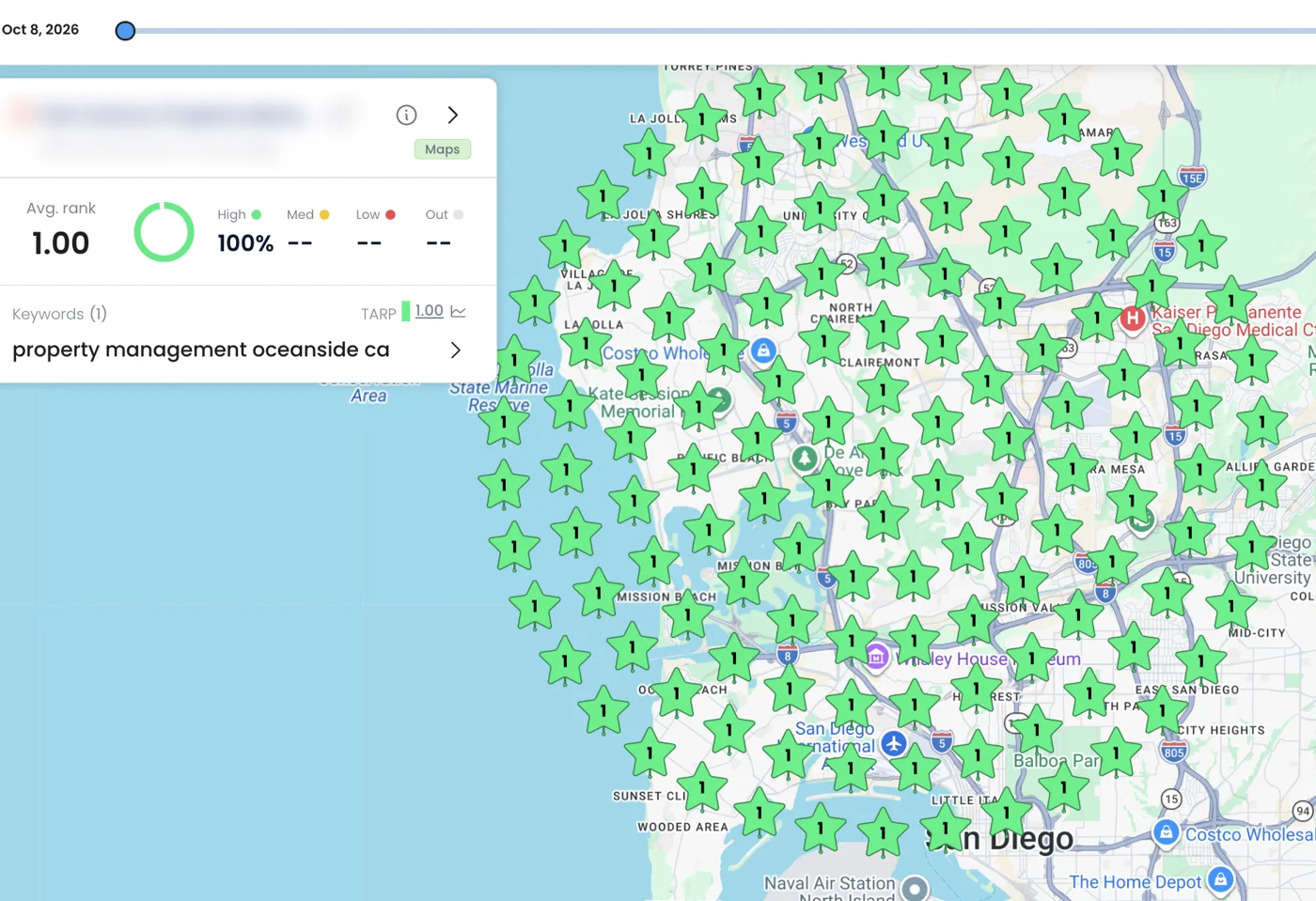
- map pack visibility (we use tools like Local Dominator and BrightLocal)
This has all been a lot, I know.
To help make all of this easier to apply, there’s a realistic 30-day action plan below.
What Gets a Property Management Website Demoted Now?
Most of what gets property management sites in trouble with Google today started as a shortcut that used to work.
- Mass-produced AI blog posts nobody edits or adds real experience to (Google calls this scaled content abuse)
- City-swap location pages, the doorway pages from step 3
- Asking only happy clients for reviews, or buying them. Google doesn’t allow it, and the FTC now fines fake or suppressed reviews
- Buying links or joining link networks
- Changing the date on old posts without really changing them
Our Own Example: In July 2026 we swapped this guide for an AI rewrite. The rewrite averaged position 30.8 on Google, where this original had averaged 9.6. So we brought the original back.
30-Day Property Management SEO Action Plan (Simple + Realistic)
SEO can feel overwhelming because there are so many moving parts. The easiest way to make progress is to work in short sprints and focus on the highest impact items first.
This 30-day plan is built to help you get wins without trying to do everything at once. It prioritizes trust, conversions, local visibility, and content that actually matches owner searches.
If you do nothing else, follow this plan and you’ll already be ahead of most of your competitors.
Week 1: Outcomes + Trust + Structure
- Define your goal + property management lead type
- Improve social proof signals
- Fix core page structure (home page)
Week 2: Conversion + On-page cleanup
- CTAs, forms, trust near CTA
- Titles/headings/internal links
- Add service page FAQs
Week 3: Local visibility
- GBP improvements
- Photos + reviews
- NAP consistency
Week 4: Content cluster launch + authority
- Publish 2 posts in one cluster
- Add “How it works” type content on home page (if missing)
- Partner outreach for mentions/links
Bonus: Example Content Calendar: Long-Tail Owner Searches (Nationwide + Localized)
The easiest way to build SEO momentum is to stop guessing and start answering what owners are already searching. Long-tail topics may not have huge search volume, but they bring in more qualified visitors because the intent is specific.
The other key is localization. You don’t want to write generic content that could apply to any city. Even if you use [CITY, STATE] placeholders, the structure should make it easy to add local notes, local examples, and internal links to your location pages.
Below are a few clusters that work well nationwide and can be localized for your market.
Fees & hiring cluster blogs:
- How Much Does Property Management Cost in [CITY, STATE]?
- Property Management Fees Explained in [CITY, STATE]
- Is It Worth Hiring a Property Manager in [CITY, STATE]?
- How to Choose the Best Property Management Company in [CITY, STATE]
Tenant issues cluster blogs:
- What Happens When a Tenant Stops Paying Rent in [CITY, STATE]?
- How Long Does the Eviction Process Take in [CITY, STATE]?
- Tenant Breaking the Lease in [CITY, STATE]: What Landlords Can Do
- Unauthorized Occupants in a Rental in [CITY, STATE]: What to Do
- Eviction vs Cash for Keys in [CITY, STATE]: Which Makes More Sense?
Property Management SEO FAQs
How long does SEO take to work for property managers?
Some of these strategies can produce quick bumps in rankings, but rankings aren’t the end goal and SEO is an investment, an asset that you are building for the long run. IF you were to do everything covered in this blog, you’d notice an increase in traffic and leads within 2-4 months, with the biggest improvements coming around months 8-14. A lot depends on your market and competition. More in how long SEO takes for a property management company.
Is Google Business Profile important for property management companies?
Your Google Business Profile or GBP is just as important as your website. One is no good without the other. Your website provides the info and relevancy signals that help your Google Profile perform better and rank for the right searches, and your Google Profile is the actual place property owners first see you, and then head to your website to learn more.
Is SEO still worth it if owners ask ChatGPT?
Yes. In our 2026 study Google Search and the Map Pack still brought 50.6% of owner leads, and AI tools lean on the same signals: your site, your reviews and where you’re mentioned. Good SEO is how you get named in both.
Should I build a page for every city I serve?
Only for the areas where you can say something real about that area: neighborhoods, property types, local examples or team presence. A page per city with the name swapped can hurt you.
Do tenant searches help or hurt my SEO?
They don’t hurt, and tenant pages belong on your site. But tenant traffic doesn’t sign management agreements, so measure SEO by owner leads, not total visitors.
How many Google reviews do I need?
There’s no magic number. Look at the three companies in the map results for your main city and aim to pass them on count and recent reviews, then keep asking every client.
If you need any help or have questions about any of this, scroll down to the form for a free analysis on your online presence or get in touch with our marketing agency for property managers.